

Australian engineering students help Cambodian communities to recycle plastic
BY ALEX McCART More than 30 Australian engineering students travelled by bus, by ferry and by oxcart to Koh Chraeng, an island on the Mekong river in Cambodia’s east. The island has villages of less than 800 people and expansive farming fields...


BY ALEX McCART
More than 30 Australian engineering students travelled by bus, by ferry and by oxcart to Koh Chraeng, an island on the Mekong river in Cambodia’s east. The island has villages of less than 800 people and expansive farming fields. But the students did not come here to holiday.
The students were on a study tour run by Engineers Without Borders (EWB). The organisation encourages students to apply their classroom knowledge to problems overseas. On Koh Chraeng, students observed, lived and interviewed villagers over a four day period. At the same time, these students also attempted to develop sustainable designs to improve the island.
One local NGO, Cambodian Rural Development Team (CRDT), identifies rubbish and plastic bottle waste as one of the major issues the island’s residents face. Plastic bottles do not degrade, which damages the environment for these farming communities. CRDT’s project manager, Dim Bin, says the organisation finds it difficult to teach the older population not to litter.
“CRDT have one program we call Environmental Education and Waste Management Program,” Mr Bin said.
“Mostly we focus on a target village, not all the place because we don’t have the funds.”
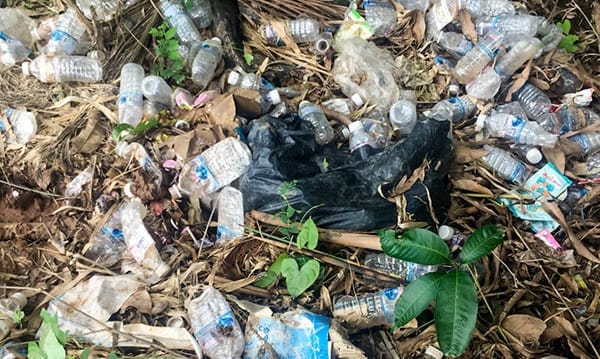
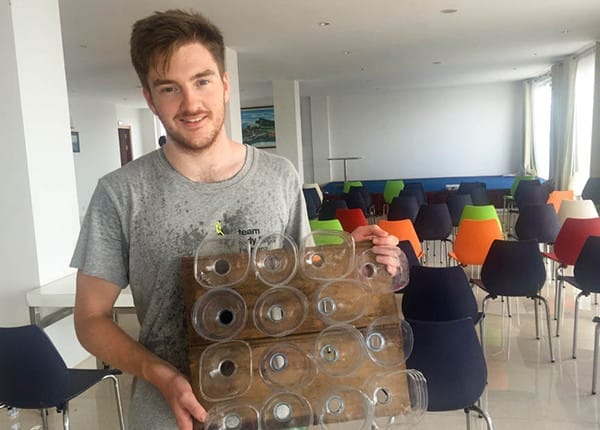
Some of the Australian engineering students decided to tackle this issue. Fifth year civil engineering student Toby Shutler and his team designed a rudimentary air conditioner from the island’s plastic bottle waste, based on a design used in Bangladesh. The University of Melbourne student also suggested the bottles could be remade into pot plants, shovels or even hacky sacks.
“We wanted to spread the concept that waste should be viewed as a material rather than just as waste, because at the moment [the villagers] just chuck it out and burn it and that is bad for their environment and their health,” he said.
“So we figured if we could give them some potential designs that you can make out of a plastic bottle it might be a good start in promoting recycling and reuse of plastic.”
RMIT mechanical engineering graduate Ryan Worland and his team designed a rubbish collection service utilising only local materials.
“Using existing tools and equipment that were around the community, such as empty rice bags for bins, where [the villagers] could collect all the bottles in one place for disposal.
“Part of [the design] was [to create] a convenient way for the garbage man to carry and collect everything from the individual homes. Which was basically a giant backpack,” he said.
Sokha Chum is the Chief of Prek Village, a small community on Koh Chraeng. He says his village wants to use the designs created by the engineers to decrease the amount the garbage. Currently, his village burns or buries litter, as there is no recycling system. The farmer also understands the current method damages both the environment and the people’s health.
“I want all the people in my village and other village to implement [education] on how to clean the environment,” he said.
The students say creating these designs was not easy due to language and cultural barriers. It also took time for students to understand that the village’s way of living wasn’t full of problems.
“I expected there to be 101 things to jump out at me that needed fixing or changing when I arrived,” Ryan Worland said.
“But from talking to the community that’s not what I saw. I found the community was very happy with the systems and processes and equipment they had in place to go about their daily lives.”
EWB will next run a similar program in Nepal during December.
[Sokha Chum interview conducted via a Khmer/English translator.]


