

Human Centred Design 101: How Australian students engineered solutions for a Cambodian village
BY ALEX MEIBUSCH There can be many ways to approach an engineering design problem. While based in Cambodia’s Kratie province, a group of Australian engineering students were experimenting with a method that was new to them. The students were...


BY ALEX MEIBUSCH
There can be many ways to approach an engineering design problem. While based in Cambodia’s Kratie province, a group of Australian engineering students were experimenting with a method that was new to them.
The students were discovering the principles of human centred design, while simultaneously learning about life in rural Cambodia.
In traditional design, the designer usually considers the the economic feasibility of a project first.
Human centred design contrasts with traditional design in that the end user of the product is at the centre of the designer’s thoughts throughout the entire process.
“It’s about trying to keep flexibility and trying not to lock yourself in too early,” said Andrew Drain, an Engineers Without Borders design summit mentor and current PhD Candidate at Massey University in Auckland.
“It’s really this learning process where you’re constantly iterating ideas and prototypes back through consultation with the users the whole time.”
Mr Drain was a mentor for a group of engineering students who designed a prototype to help raise productivity of corn planting.
The students spent four nights in Kbal Koh Village, near Kratie, where corn production is vital a part of the local economy.
“Obviously, corn was their main source of income. You saw it everywhere,” said Arunika Weeratunga, an engineering student from Monash University.
“We wanted to know more about the corn planting process. We interviewed three or four of the farmers and extracted a lot of information from them about how it’s done.”
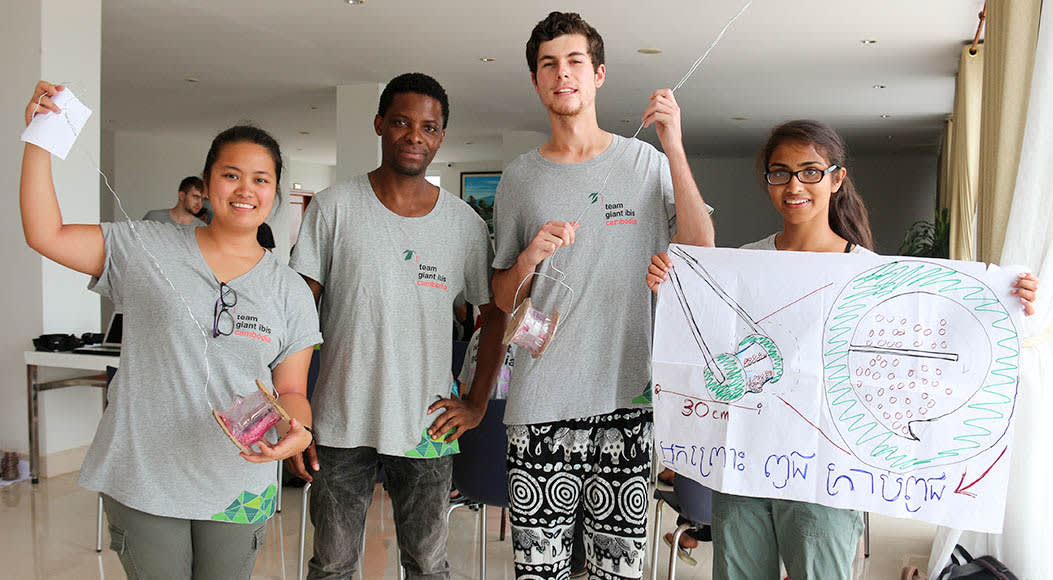
Another student in the group, Allissa Abrenica from UTS, said it was only after speaking to the local farmers that the students decided to focus on the productivity of the planting process.
“We were narrowing it down but not as narrow as proposing a solution… because productivity is a very broad term,” she said.
Currently, the farmers use an ox-cart to dig lines while a famer follows behind and manually plants the seeds.
“They [the farmers] had mentioned that there’s this 30 centimetre spacing that’s important. They said it [the 30 centimetre gap] was to allow each plant to grow to its optimum capacity,” Ms Weeratunga said.
“So we decided the 30 centimetre gap was the most important. Because that was a main issue, that they were just estimating it.”
The students’ solution was to create a prototype seed dispenser that is similar to a trundle wheel. The dispenser is designed to drop a single seed at 30 centimetre intervals.
The prototype also has other benefits. It gives farmers a faster and less labour intensive way of planting of the crop.
Andrew Drain points to Chinese appliance company Haier as a good example of an organisation that designs products to the needs of the user in a developing community.
A large number of their washing machines sold in the rural Chinese market were breaking down, but after doing some market research they realised the washing machines were being used for washing vegetables as well as clothes.
“These consumers were really trying to get as much value out of the product as possible through multifunctionality,” he said.
“So what they [Haier] did was went back and redesigned that model to allow for that. They didn’t tell their consumers, no you can’t do that, they pulled that knowledge into their design.”
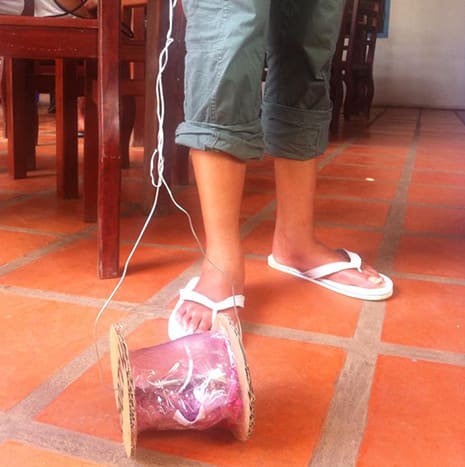
While the students’ seed dispenser prototype was made of plastic and cardboard, the real dispenser could feasibly be made from recycled materials found on the island.
“The handle would be bamboo, the barrel in the middle would be recycled plastic, the wheels would be wooden,” said Tim Anderson, a student from RMIT University.
“If there’s not enough friction on the wheels, you could use rubber from old motorbike tyres.”
When the students presented their prototype to the village chief of Kbal Koh, Khiev Malai, the feedback was positive.
Mr Malai said he wanted to work out a way to incorporate the digging and sewing into one design, but he was confident the prototype of the seed dispenser was a step in the right direction.


