

The Pine Gap Convergence and Its Greater Consequences


“Standing on the hill, overlooking the rally, I could see hundreds of cars lined up on the road, yeah, that was pretty special," activist Julie Monteiro said.
In July 2026, organisers claim more than 600 activists gathered outside Alice Springs to protest Pine Gap, the joint Australia–US intelligence facility they say enables wars overseas.
Officially, Pine Gap is one of three facilities jointly operated by Australia and the United States. In a 2023 statement, Defence Minister Richard Marles said the facilities provide intelligence and communications capabilities Australia could not achieve alone, while contributing to counterterrorism, arms-control monitoring and early warning of ballistic missile launches.
Monteiro, a member of Students for Palestine at the University of Melbourne, was one of the activists who answered the call to assemble at the military facility. Monteiro describes Pine Gap as a symbol of unwanted foreign military presence and a push for Australian militarisation.
“The money being put into this build-up of militarisation could be put into so much more important things, such as health care”.
Organisers believe the gathering is the largest convergence at Pine Gap since 1987, drawing activists from across Australia not only to protest the base itself, but to challenge what they see as a broader and accelerating militarisation of the country.
It brought together Palestine solidarity activists, opponents of AUKUS, anti-war groups, campaigners targeting weapons manufacturers and people concerned about the increasing Australian and US military presence across northern Australia.
“It's a way in which we can stand up to the government and say no to the build-up of militarisation on this continent," Monteiro said.
A Case for Convergence
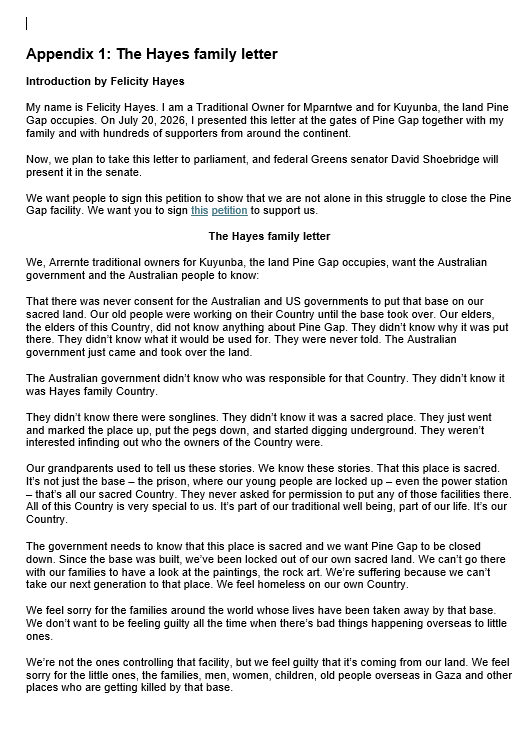
The Hayes family, Traditional Owners for Kuyunba, where Pine Gap is located, said their elders never consented to the facility being built on their Country and were never told what it would be used for.
An open letter from the Hayes family was presented to the gates of Pine Gap on the day of the convergence and outlined the demands for the base to be closed.
“Since the base was built, we’ve been locked out of our own sacred land,” the letter said.
“We’re suffering because we can’t take our next generation to that place. We feel homeless on our own Country.”
Delivering the letter to Pine Gap was one of many rallying calls to activists around the country.
Jorgen Doyle, a convergence organiser and
member of Mparntwe for Palestine, the traditional owners name for Alice Springs, said the event was intended to answer the call from the Hayes family and/unite anti-militarisation movements.
“We saw the purpose of the convergence as consolidating that mobilisation that has happened over the last three years and beginning to bring together all those groups that have formed in resistance to the genocide in Gaza on this continent,” he said.
The immediate demand was to close Pine Gap. But for organisers, the facility also represented something much larger.
“I think it really stands in for the entirety of the US military presence on this continent,” Doyle said.
Doyle explained that Pine Gap can no longer be seen as serving purely defensive purposes and the technology behind Pine Gap has changed, referencing the Snowden leaks
The Snowden leaks refer to classified US National Security Agency (NSA) documents released by whistleblower Edward Snowden and later published by the ABC in 2017.
The documents revealed Pine Gap’s role in detecting and geolocating electronic signals, including communications, and described the facility as playing a “significant role” in supporting US intelligence and military operations.
According to the document, the base's capabilities allow analysts to gather intelligence from signals and geolocate their origin, which can help locate potential targets.
Before the recent convergence, Doyle had already protested Pine Gap’s alleged role in Gaza. He was arrested during a 2025 blockade of the facility and later appeared in court over the protest. During Doyle's sentencing, Pine Gap researcher Professor Richard Tanter provided expert evidence arguing it was “highly probable” intelligence collected through Pine Gap had been provided to the Israeli military.
Doyle said changing the language used to describe Pine Gap was “incredibly important”, arguing terms traditionally associated with intelligence gathering can obscure the facility’s role in military operations
“There’s a whole range of obfuscating language that gets used to obscure the violence that the base does and to obscure the fact that it is an offensive military installation,” Doyle said.
For Doyle, changing the language around militarisation also means changing how Australia describes its own role.
Rather than Australia simply being “dragged” into a future conflict, Doyle argues the government is making deliberate choices about the military infrastructure it allows on Australian soil.
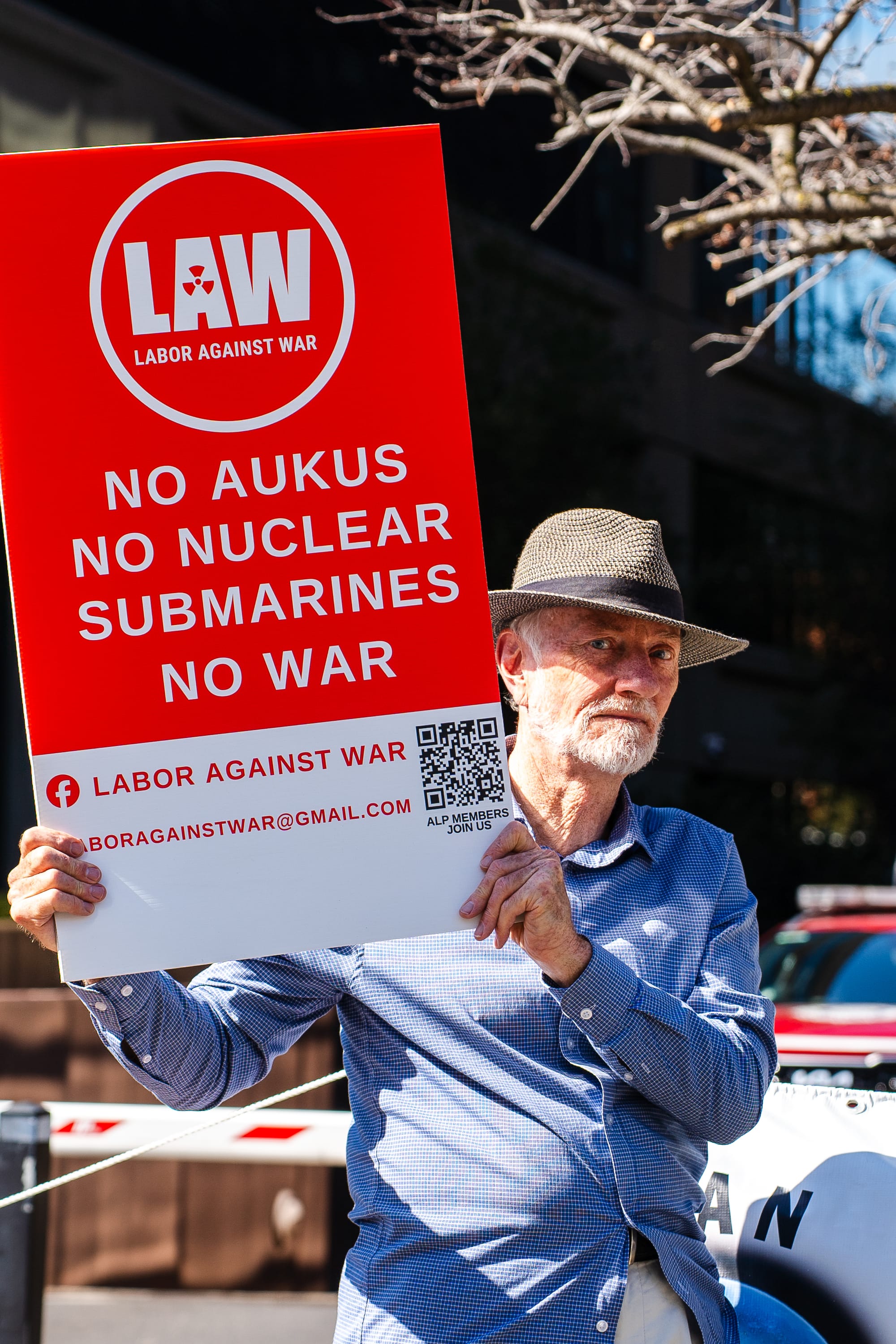
“I think the Australian Government chooses it,” Doyle said.
For many activists like Doyle, Pine Gap has become a symbol of what they see as a growing build-up of militarisation in Australia, which, if left unchecked, could lead to further wars.
Deterrents or Destabilisers
A Parliament of Australia report describes the facility as a ground control and processing station for satellites collecting signals intelligence, including missile telemetry, radar signals and communications
Professor Stephan Frühling, who teaches and researches at the Strategic and Defence Studies Centre at the Australian National University, argues that Pine Gap and other military bases are essential as a militaristic deterrent.

“The best way to prevent conflict is to maintain sufficient deterrence,” Frühling said.
“You’re not going to deter by being purely defensive.”
For Frühling, Australia’s military build-up is not evidence that the country is preparing to start a war, but an attempt to make one less likely.
“If you want to counterbalance the Chinese and maintain deterrence, in order to prevent conflict, the US can’t do that alone anymore,” Frühling said.
“Unless you actually maintain a regional balance of power, Xi Jinping could wake up one day and view the risks of starting a war over Taiwan or the Philippines as actually controllable”
But the same military infrastructure designed to strengthen that deterrence can also increase Australia’s exposure if a conflict does break out.
Dr Ben Zala, a researcher in nuclear politics and great power conflict, agrees to a certain point. However, for Zala, the growing militarisation is less of a deterrent and more of a potential destabiliser of the region.
Zala agrees Pine Gap can play an important defensive role, particularly through the early-warning intelligence it receives from satellites. That information can give governments more time to respond to a potential attack and has also historically helped states verify arms-control agreements.

But the same intelligence has another use: its targeting capabilities.
Because of this dual purpose, Zala warns that military infrastructure intended to deter an adversary can also become strategically important in a conflict and therefore a target. This includes Pine Gap itself.
“The whole AUKUS arrangement is absolutely a symptom of a growing arms race in Asia, but it’s also one of the drivers.”
Zala argues this military build-up is happening at a particularly uncertain moment in the Indo-Pacific. China's growing power challenges longstanding US dominance in the region, leading to a race to outgun each other.
“That drives more mistrust, more concern, more fear,” Zala said.
“These are extremely dangerous times in that regard.”


