


Australia is ageing. Can productivity grow fast enough to compensate?

For the first time in an Australian Intergenerational Report, deaths are projected to eventually outnumber births as fertility continues to fall.
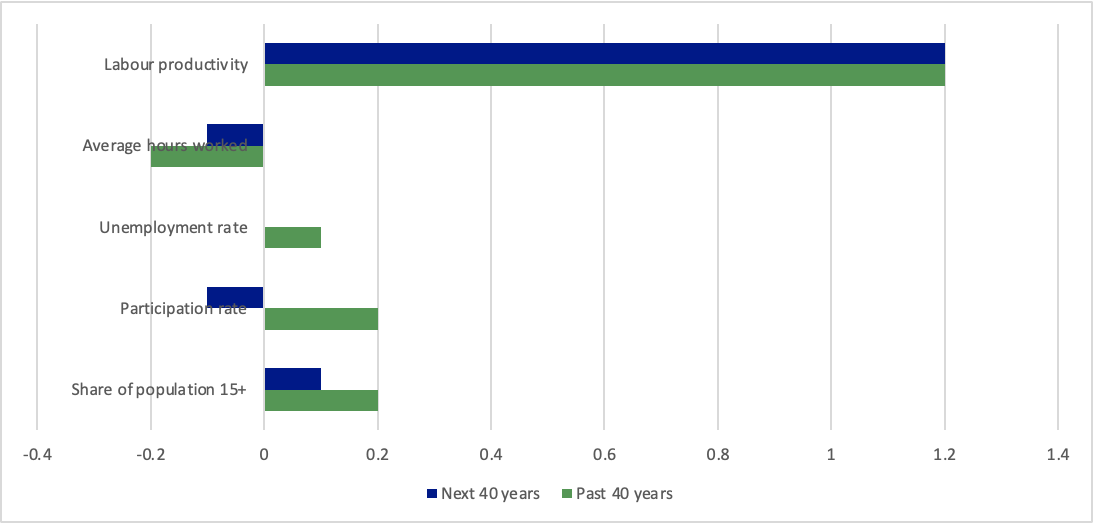
Australia's population is ageing, while the working-age share of the population is projected to shrink. Treasury is betting that stronger labour productivity – how much output is produced for each hour worked – can help close the gap. However, recent numbers show how difficult that could be.
The Federal Government’s newly released 2026 Intergenerational Report projects a bigger, richer and older Australia by 2066, with Australians living longer and incomes continuing to rise.
That leaves Australia facing an economic question that is relatively simple to ask but much harder to answer: if a smaller share of the population is working, can each hour of work become productive enough to compensate?
More people needing care, fewer people to provide it
At the same time, the number of Australians aged over 85 is projected to triple. An ageing population is not necessarily an economic problem in itself. Longer lives reflect improvements in healthcare and living standards, while older Australians continue to participate in the workforce, spend, save and contribute to the economy.
The pressure comes from a smaller share of working-age Australians supporting a growing older population. The Treasury expects Australia’s working-age population to continue growing, helped partly by migration. But as a share of the overall population, workers will become proportionately fewer as more Australians move into older age groups.
Treasurer Jim Chalmers said when releasing the Intergenerational Report that health and social assistance employment had already risen 13 per cent in three years and was expected to keep growing over the coming decade.
Treasury estimates ageing will account for around one-third of new healthcare spending. In other words, Australia will not only need to fund more care, it will need enough workers to actually provide it.
Westpac senior economist Pat Bustamante argues that demographic change will mean Australia relies on “a smaller share of the population” to fund health, aged care and other services. This makes productivity increasingly important as fewer workers support a larger older population.
Why productivity matters
When the proportion of people working falls, increasing what each hour of work produces becomes important to maintaining growth in income per person.
Treasury’s long-term projections assume labour productivity growth of 1.2 per cent a year. If that sounds modest, compounding it over four decades makes an enormous difference. The Intergenerational Report projects real income per person to be around 55 per cent higher by 2065-66.
The Productivity Commission reported that labour productivity was unchanged in the June 2026 quarter. Over the year to June, output rose 2.1 per cent while labour productivity fell 0.2 per cent, as hours worked grew faster than output.
The Commission said economy-wide productivity was barely one per cent above its average level between 2015 and 2019.
Australia's recent weak productivity performance illustrates the challenge of sustaining the growth assumed in Treasury's long-term projections.
Can technology close the gap?
Treasury identifies artificial intelligence as a potential source of future productivity growth.
The latest Intergenerational Report gives AI a much larger role than its 2023 predecessor, identifying it as one of five major transitions expected to transform Australia's economy over the next 40 years.
The Government argues AI could allow workers to produce more in less time, automate some routine tasks and make businesses more efficient. But those gains are not guaranteed. External economists participating in an RBA advisory group, noted there is still little evidence that AI has boosted productivity in other countries, and some participants said productivity could initially fall as businesses experiment with the technology.
According to figures cited by the Treasurer from the Intergenerational Report, around two-thirds of Australian businesses have adopted AI in some form, but fewer than 10 per cent describe its use as significant.
The Productivity Commission notes that healthcare and aged care are part of a growing care economy, where productivity growth has remained relatively low. It says this is partly because human-to-human interaction is an important part of delivering care.
Technology may still improve administration, diagnosis, and rostering. But the Commission says productivity gains can be harder to achieve in care than in industries where technology can more easily replace labour.
RMIT economist Dr Meg Elkins has questioned the optimism behind long-term productivity projections, arguing that previous Intergenerational Reports relied on assumptions that ultimately proved “too rosy”. She noted that when Treasury lowered its long-term productivity growth assumption from 1.5 to 1.2 per cent in 2023, its projected size of the economy in 2063 fell by about 9.5 per cent. This shows how even small changes in productivity assumptions can significantly alter long-term economic forecasts.
Productivity is only part of the equation
Higher workforce participation can increase the number of people working. Treasury expects participation to remain stronger than projected in previous Intergenerational Reports, partly because of higher participation among women and older Australians.
Migration also affects the equation. The Government says skilled migration can supplement the domestic workforce as fertility declines and the population ages, particularly in sectors experiencing shortages.
Education and training matter, too. A skilled and adaptable workforce will be better placed to respond to new technologies, while persistent shortages in health, construction and other essential industries cannot be addressed through productivity growth alone.
A 40-year assumption meets today's productivity problem
Intergenerational Reports are projections, not predictions. The latest report shows how much future living standards will depend on productivity as population growth and the relative size of the workforce can no longer do as much of the economic heavy lifting.
Australia's population is projected to age regardless. The unresolved question is whether productivity, workforce participation and migration together will increase economic capacity quickly enough to keep pace with the demands of the older population.
How Australia responds to this challenge will help shape living standards over the next 40 years.


