


How could we possibly spend more on rent, say students
Students are worried about rent increases.

Amid all the talk of federal budget restrictions on negative gearing and the capital gains tax (CGT) discount, students are worried about rent increases.
According to Anglicare’s latest annual housing snapshot, not a single rental in Melbourne is considered affordable for a student relying on Youth Allowance.
What does the housing market look like now?
According to the 2021 census, Melbourne has more than 2 million residences – and investors own more than 600,000 of them.
About 90 per cent of investors own just one or two investment properties.
Five per cent, or 115,000 landlords nationally, own more than five properties each.
Some own hundreds.
Meanwhile, Anglicare's annual housing snapshot found Youth Allowance recipients and minimum-wage earners are often paying 60 per cent or more of their income on rent.
Housing affordability is frequently framed as a supply issue, with governments and industry groups arguing population growth has outpaced construction.
But a growing number of economists and housing advocates argue the crisis is not simply about supply, but how housing is distributed and incentivised.
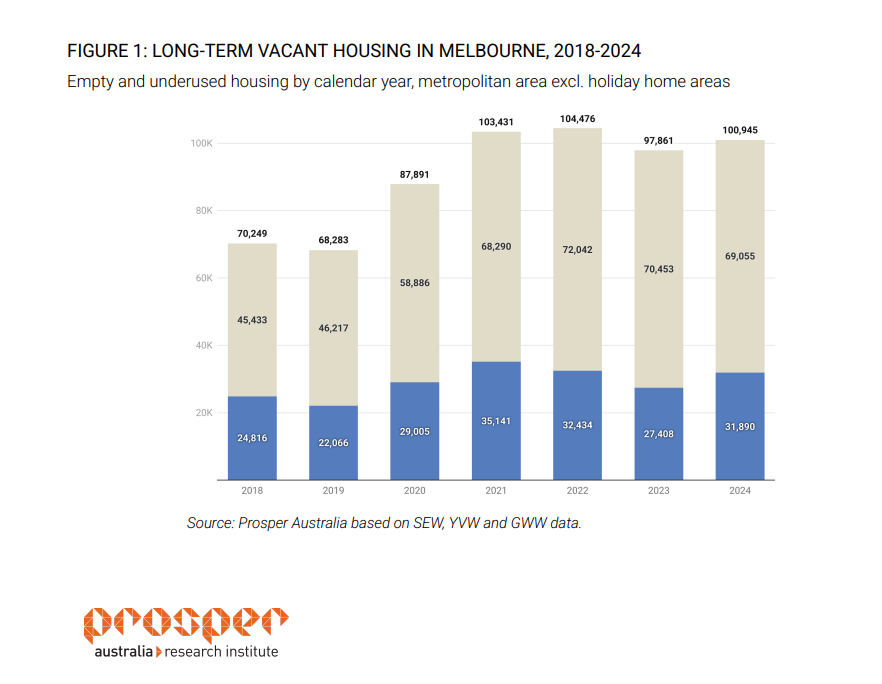
Prosper Australia Research Institute measured water usage in Melbourne homes in 2025 and found that one in 20 houses that could be rented out was empty.
The institute put this down to tax structures, such as the previous negative gearing and CGT policies, which reward owning empty houses rather than providing rentals.
Chels Hood Withey, founder of House You, a grassroots homelessness and housing equality advocacy group, said Melbourne’s housing crisis is solvable, with housing stock growing 19 per cent over the past decade against 16 per cent population growth.
“We've got a system now that rewards house hoarding over housing people,” Hood Withey said.
“We've got enough houses; it's just that the supply is in the hands of the few.”
Hood Withey challenged the view that investors supply housing, given they invest in existing homes 80 per cent of the time.
“Even with the supply that these investors do develop, they will say very plainly that they drip-feed access to the houses,” she said.
Hood Withey said they don't put houses all on the market at once, instead giving access gradually to keep prices high.

Grattan Institute Deputy Program Director for Economic Prosperity Erin-Lea Brown said a range of factors contributed to the affordability crisis, including the concessional tax treatment of investors.
“The specific combination of negative gearing and the capital gains discount has made residential property attractive as an investment, as well as a lack of supply, [which] has led to a situation where you've got high prices,” Brown said.
How is the housing market changing?
From 2027, the tax treatment of property investors will significantly change.
Senior Lecturer in Finance at Monash University Dr Wayne Wan said the method being phased out was designed to reward investors.
Under negative gearing, investors could deduct losses made on investment properties from their taxable income, reducing their overall tax liability.
The new system will allow only the losses incurred by investors on new builds to be counted as a deduction against taxable income, while existing investments retain their concessions.
The CGT discount, which previously allowed investors to pay tax on only half the profit made from a property held longer than 12 months, will also change.

“In the future, they will not directly give you the 50 per cent discount … They will consider the inflation during this entire holding period,” Dr Wan said.
Brown said these are changes the Grattan Institute has been recommending to reduce over-valuation of certain investments, with owner-occupiers likely to benefit at the expense of investors.
“The 50 per cent discount overcompensated property investors for inflation over the past 25 years, but potentially under-compensated other asset classes,” Brown said.
“We've seen the prices of residential property grow over time, because we've had a lot of people using it as a driver of wealth creation.”
Brown said the combination of tax concessions contributed to declining home ownership rates and to higher rents, with first-home buyers pitted against investors.
Dr Wan predicted that "of course, some investors will be discouraged”.
But he said there will be externalities and questioned whether this policy will be effective in cooling down market prices.
“Although the intention of introducing this policy is ... so first-time homeowners theoretically have less competition, I do not feel very optimistic about this.”
What do the changes mean for renters?
Housing is considered affordable when it accounts for no more than 30 per cent of income.
Renters, particularly students, are already stretched, with many spending well beyond the 30 per cent affordability threshold on housing.
The impact is largely speculative, and economists have varying predictions about how investors will adjust their rents.
“Our modelling showed that, in response to these changes, property prices would probably fall by about one per cent but … you would see a larger share [of] owner occupiers, and less investors,” Brown said.
The Grattan Institute predicts this will cause a $1 per week increase in median rents across Australian capital cities, while Treasury has modelled a two dollar per week increase in median rents.

Brown said the reduction in tax concessions for investors is unlikely to directly cause a large increase in rents.
She said landlords are incentivised to charge as much rent as the market allows, rather than base rents on a price that correlates with the costs of running the rental.
In other words, Brown argues landlords already charge as much rent as tenants are willing to pay, regardless of changes to their tax costs.
“If we think that landlords will charge more now that they don't have access to negative gearing, we also have to assume that landlords have been charging rent under what they might get in the market.”
Dr Wan disagreed, saying that although rental prices are not directly related to the price of supplying the rental, landlords are likely to shift the burden of lower tax concessions to renters.
“In the short term, I think the supply is relatively inelastic, and investors face this higher cost that they bear,” he said.
“They will immediately have the incentive to increase their rent, but, of course, they will also test the market.”
Dr Wan said landlords still have to charge a competitive price, but Melbourne’s tight rental market currently favours property owners over renters.
Hood Withey said House You sees the claim that investors will substantially increase rents as a scare tactic that relies little on the substance of the policy.
“You and I both know that negative gearing is being grandfathered, so all existing investors who have rental properties will not be affected by the recent changes,” she said.
“That feels like a very disingenuous thing for investors who are landlords to be saying to the public. They will continue to enjoy negative gearing indefinitely.”
She said if you own a second house or you have multiple properties, you have a financial obligation to keep yourself viable.
“Is the Australian dream to own your own home, or is the Australian dream to own someone else's home?" she said.
“We need to move away from housing as an investment and see it as the human right that it is, so that everybody has access.”


