


Students outside the system: Firms asking grad students for their ATAR and high School

When law student Angus clicked on the drop down list of schools on his graduate law firm application, his regional high school wasn’t there.
Instead, he was forced to put down an incorrect school on the application and list in the notes at the end that he had been forced to put down the wrong answer.
This is a challenge regional and rural students face in applying for graduate positions at leading consulting, business and law firms.
Angus (who has chosen not to be named) said entering his ATAR and his school was a common occurrence in graduate applications to law firms.
He also said he was often asked what school he attended throughout the course of his law degree.
“There were Open Days I was going to… the Dean that was doing the law talk was going around the room asking what school everyone was from.”
“They asked me where I was from and I said I was rural.”
“The Dean’s response was ‘well you know, the ATAR entry into this school is quite high. Have you considered something like Victoria Uni instead?’”.
Angus said this discouraged him to even apply to the university, despite ultimately meeting the ATAR requirements..
Students from rural and regional areas remain underrepresented in universities, according to Higher Education Statistics.
Angus now works for a leading law firm, but he said his path to get there was anything but straightforward.
“I didn’t get in through front door pathways for clerkships or grad roles,” he said.
“I didn’t have any contacts outside of the rural areas and because I wasn’t able to live at home, I wasn’t able to meaningfully do unpaid internships.”
He said he felt this meant that he had to do "as many things as possible to try and get to that point of difference.”
Asking for ATARs
Many leading business, law and consulting firms ask students to provide their ATARs in graduate applications.
McKinsey’s Business Analyst Recruitment 2026 asked students to submit their CV “clearly stating your high school with high school grade e.g. ATAR/OP/VCE/SACE score.”
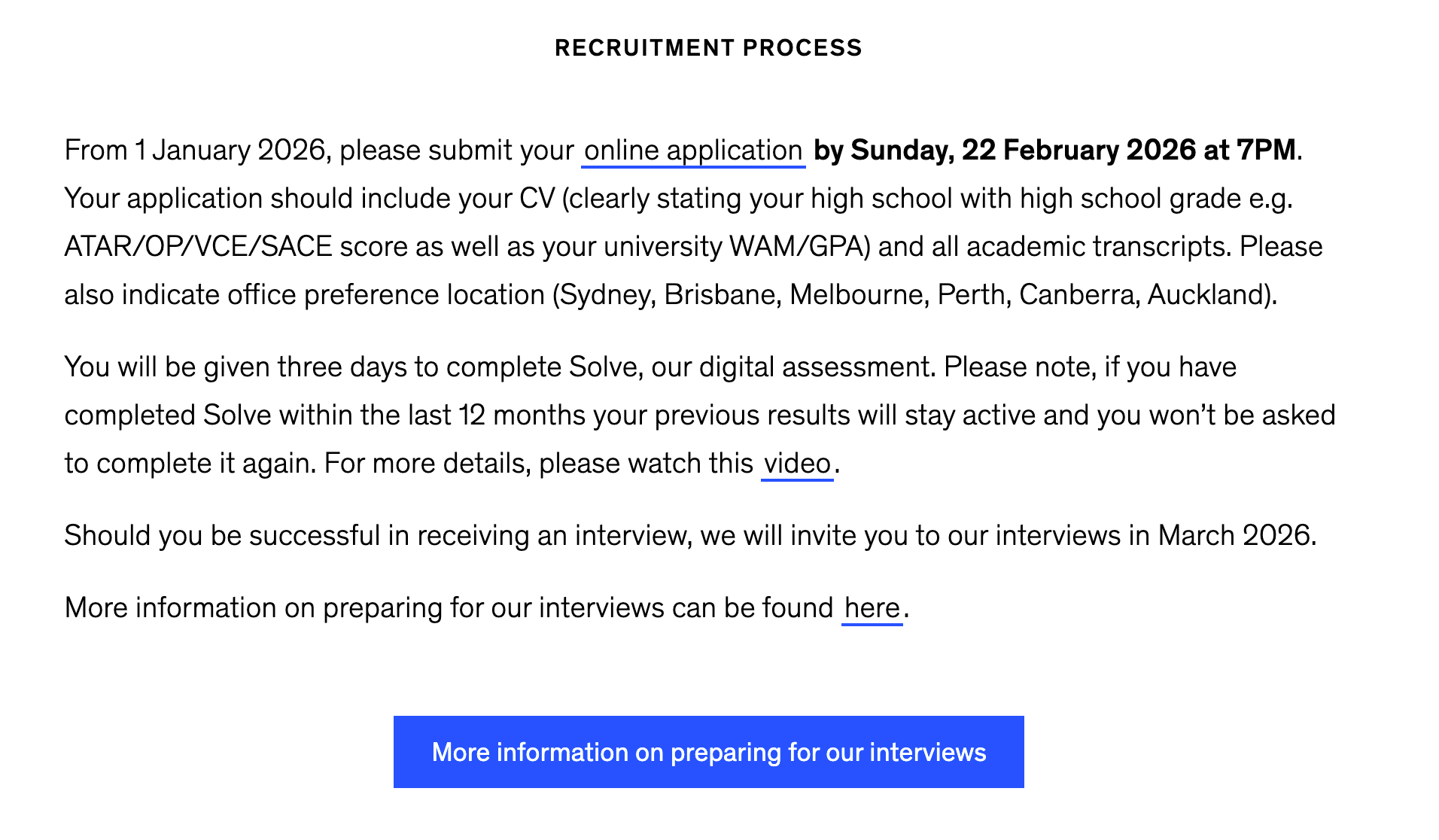
McKinsey told MOJO News the ATAR was requested as an “indicator of a candidate’s sustained academic performance” that is “considered alongside a range of other criteria.”
Law firm Harmers also asks students applying to their 2026/2027 Summer Clerkship program to include their ATAR results in the application.

Harmers has been contacted for comment but is yet to respond.
No accounting for adjustment factors
Catholic College Wodonga Careers Advisor Sandie McKoy said knowing these firms were asking students for their ATARs was concerning.
“I’d have to question the purpose of knowing what the ATAR was because we know that the ATAR is not a good measure of things like soft skills,” McKoy said.
“These firms don’t take [adjustment factors] into consideration either.”
VTAC Equity schemes and scholarships (formerly the Special Entry Access Scheme) allows disadvantages faced by students, such as regional living or financial hardship, to be taken into consideration by universities when considering applications.
Addtionally, most Australian universities have their own equity schemes that give students adjustment factors depending on their background.
However, when firms are asking graduate students to provide their ATAR these same adjustment factors are not included.
Whether disadvantage is acknowledged is up to each firm’s discretion, meaning it is in the hands of individuals firms to decide whether they recognise and account for disadvantage.
According to the Australian Bureau of Statistics, regional and rural students are more likely to be from low socioeconomic status (SES) backgrounds.
Law and commerce degrees have also seen commencements among low SES students drop by 17.7 per cent from 2020 to 2024, according to Innovative Research Universities.
Lower SES students also often prioritise paid work over the unpaid extra-curricular activities that firms value.
Angus said he couldn’t afford to do any unpaid internships across the course of his degree.
“I worked almost full-time hours,” he said.
McKoy believes there needs to be more understanding in law and business firms of the disadvantages faced by regional and rural students who apply for graduate positions.
“These students don’t necessarily have networks in the cities,” she said.
“They’re trying to work to be able to live there and then also trying to build up connections and networks as well.”
McKoy said she’s spoken to regional and rural students who have felt that there has been a level of prejudice against where they lived and what school they attended.
“They had a perception that possibly they didn’t get positions because they came from a school that maybe wasn’t in a pipeline towards that particular firm.”
For Angus, reaching parity for rural and regional students in accessing graduate law positions will take a lot more work.
Applications to these firms, he said, “should come down to your university subjects and law qualifications.”
“I don’t believe your ATAR should be a consideration whatsoever for your ability to do a job like law.”


