


Homophobia gets a free kick in men’s sport
Men's sport is plagued by homophobic language and continues to be a hostile environment for LGBTQIA+ discrimination.

Australian rules football player Oscar Boulter is crying after barely making it off the field. His team has not lost, nor has he been physically injured. It’s for a much more devastating reason.
‘‘I've been called a f—– and it's just completely broken me,’’ Boulter says, recalling what he told his coach and fellow team players in the locker room.
This is not the first time Boulter has heard the slur used, but it is the first time it’s been directed at him.
‘‘You'd almost freeze up and you'd be like, s—… do I belong here?’’ he says.
Boulter's experience is not a unique one.
A report by VicHealth shows 40 per cent of young queer people have directly experienced LGBTQIA+ discrimination, especially verbally.
Additionally, over half of male athletes admit they have used homophobic slurs over the course of a fortnight, according to a study by Out on the Fields.
So why is homophobia so commonplace in men’s sports, especially AFL?
Crossing the line of homophobia
Lecturer of Communication of Sports Media at Deakin University Dr Kasey Symons says homophobia is normalised by the rigid gender expectations of fans and players.
‘‘Men’s sport was created… to promote masculinity, [and] to build strength,’’ she says.
‘‘That creates an environment where if you deviate from those perceptions of what masculinity is, that you are not welcome.’’
Boulter says he saw these rigid expectations in how footy players interacted with each other on and off the field.
‘‘[We’re] hanging out with men, but it's not gay, God forbid it's gay,’’ he says.
Symons also says much of what is being played out in AFL games is ‘‘a reflection of broader culture’’ within Australia.
‘‘It's very sexist, misogynist, racist, which is really difficult to say for something that… a lot of people love,’’ Dr Symons says.
‘‘Those [homophobic] terms are minimalised and laughed off and phrased as banter.’’
Boulter says he saw how this normalisation of toxic behaviour was accepted not just by the players, but by the community.
‘‘The whole sticking chest out and screaming… that blokey camaraderie is seen on the field,’’ he says.
‘‘The parents, the players, the fans, everyone sees it.’’
This has a direct effect on queer players with 73 per cent of people believing youth sports environments are not safe to come out in, according to an Out on the Field’s study.
The AFL has made efforts to try to combat these attitudes, including obligatory LGBT training for official players and coaches.
However, the AFL also faces much criticism about its lenient punishment of homophobia.
The AFL tribunal recently accepted an appeal to reduce Lance Collard’s ban on playing after he made a homophobic slur in April. The tribunal said Collard's sentence was too severe on the defence that ‘‘football was a hard game’’ and use of homophobic language is ‘‘commonplace’’, a statement which AFL HQ attempted to distance itself from.
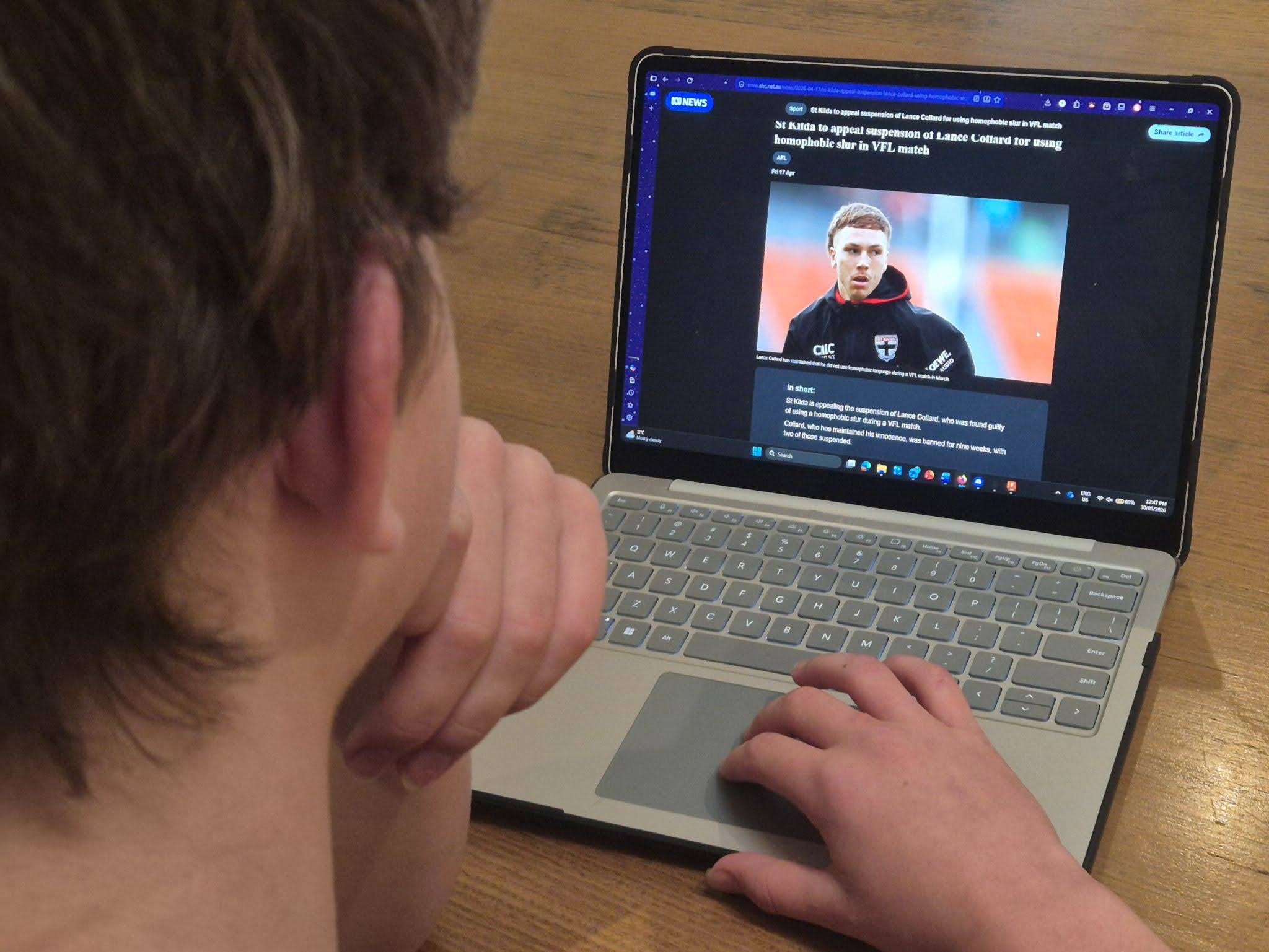
Players such as Koby Evans, Izak Rankine, and Riak Andrew have also faced bans by the tribunal for homophobic language in the last year.
Boulter felt this cheapened much of the progress the AFL had made in supporting LGBTQIA+ people.
‘‘That was one of the worst things I've ever seen, just the most backward backtracking,’’ he says.
Queer players on the mark
Queer advocacy and representation plays a role in combatting much entrenched homophobia, both locally and internationally.
Mitch Brown and Leigh Ryswyk both made AFL history in the last year when they were the first to come out as bisexual and gay, respectively.
Symons says that while this was only a small number compared to other sports, it was a big deal for AFL since ‘‘we've had just no one before’’.
Brown and Ryswyk’s choice to come out publicly and be part of queer representation had an impact on Boulter.
‘‘You have someone like Mitch, like Leigh, who can actually give their voices and talk about what it means to be a queer footballer at the highest level,’’ he says.
But Symons says there was still a long path to go in widespread acceptance.
‘‘They feel supported by communities, but they are also experiencing significant trolling,’’ Dr Symons says.
This trolling is evident nowhere more than on the field.
Just last month, Collingwood’s Isaac Quaynor was booed by members of the Adelaide Crows crowd.
Last year, Quaynor was the subject of homophobic slurs by Izak Rankine, and many Crows fans subsequently blamed Quaynor for Rankine’s suspension.
Mitch Brown criticised Crows coach, Matthew Nicks, on ABC Melbourne for not calling out the booing sooner, saying the silence was ‘‘deafening’’.
This discrepancy in acceptance is even more starkly contrasted by the significant leadership that AFLW has made for LGBTQIA+ advocacy.
In AFLW, the attitude is markedly different: fans and players are openly queer and accepting of diversity, and the league annually holds a Pride Round which draws in record crowds.
Symons says this is because women’s sports was started in defiance of exclusion.
‘‘They have welcomed people into those spaces that they built for themselves,’’ Symons said.
‘‘Professional men's sport is often a ‘come as you should be’ environment where professional women's sport is a ‘come as you are’.’’
Boulter says much could be learned from women’s approach to LGBTQIA+ inclusion of sports.
‘‘We're behind in terms of the inclusiveness that the women's game comes with."
Some hope comes with new queer and gender diverse training, where LGBTQIA+ Australians might have a better chance of support at a community level.
But much work still needs to be done.
Recent research published in Front Psychology found that Australian sport required more policy and practice to engage LGBTQIA+ people, but that many volunteer-run community clubs lacked the resources and education.
How to gather round LGBTQIA+ people in sports
Symons says actionable change can be as simple as just tolerating everyday diversity in AFL fan crowds.
‘‘Just be a fan, don't worry about what anyone else is doing,’’ Dr Symons said.
‘‘They're not taking anything away from your sporting experience, they are enjoying it in their own way.’’
Visibility overall leads to more acceptance in teams, as Boulter experienced.
‘‘As soon as people were aware there was a queer player on the team, people started to stamp out the language,’’ Boulter said.
He also said the best support comes from simply supporting queer people exactly as they are.
‘‘You're one of the toughest blokes out there just by going on the field,’’ Boulter said a coach told him when he came out.
Boulter still tears up recalling what that support meant to him.


