


Is Australia’s history of disabled policy doomed to repeat itself?
Australia has a long, jaded past with disabled education policy, and recent NDIS cuts may be doomed to repeat history.

‘‘I am scared for my life,’’ says Sudhashree Somers, 27, following the 2026 NDIS cuts.
Somers is an artist and studying Disability and Community Inclusion.
She lives with autism as well as severe mental health conditions.
Somers says she needs a support worker around her at all times to ensure her safety.
Somers recalls what life would go back to from before she accessed NDIS funding.
‘‘I would probably have to drop out of uni, I would have to stop working,’’ she said.
‘‘I would be almost housebound and I would pretty regularly end up in hospital.’’
The consequences would not end there. Somers listed some of the domino effects NDIS cuts would have on her family as well, including her sister’s education.
‘‘My mum would have to quit work,’’ she said.
‘‘My sister… would have to end up caring for me as well. She's doing really fabulous research work in her PhD, which will end up helping a lot of people. And that research simply won't get done.’’
Butler's new functionality test
Somers' worries for the future are not unfounded. Health Minister Mark Butler announced on 22 April that the federal government would cut $15 billion of NDIS funding by 2030.
He also said NDIS plans would now be based on functionality rather than diagnosis, and that many currently accessing funding were never meant to be eligible.
‘‘The NDIS was established to support people with significant and permanent disability, but its scope has expanded to cover many Australians with less significant support needs,’’ the Minister said.
Somers believes much of this functionality testing means that disabled people like her with fluctuating needs might fall through the cracks.
‘‘It’s hard to explain that to people sometimes… I'm really verbal, I communicate clearly, but they don't see that I can change,’’ she said.
‘‘I need someone around me 24/7.’’
According to the NDIS, just over 30 per cent of participants are considered to be high functioning, compared to around 21 per cent who are low functioning.
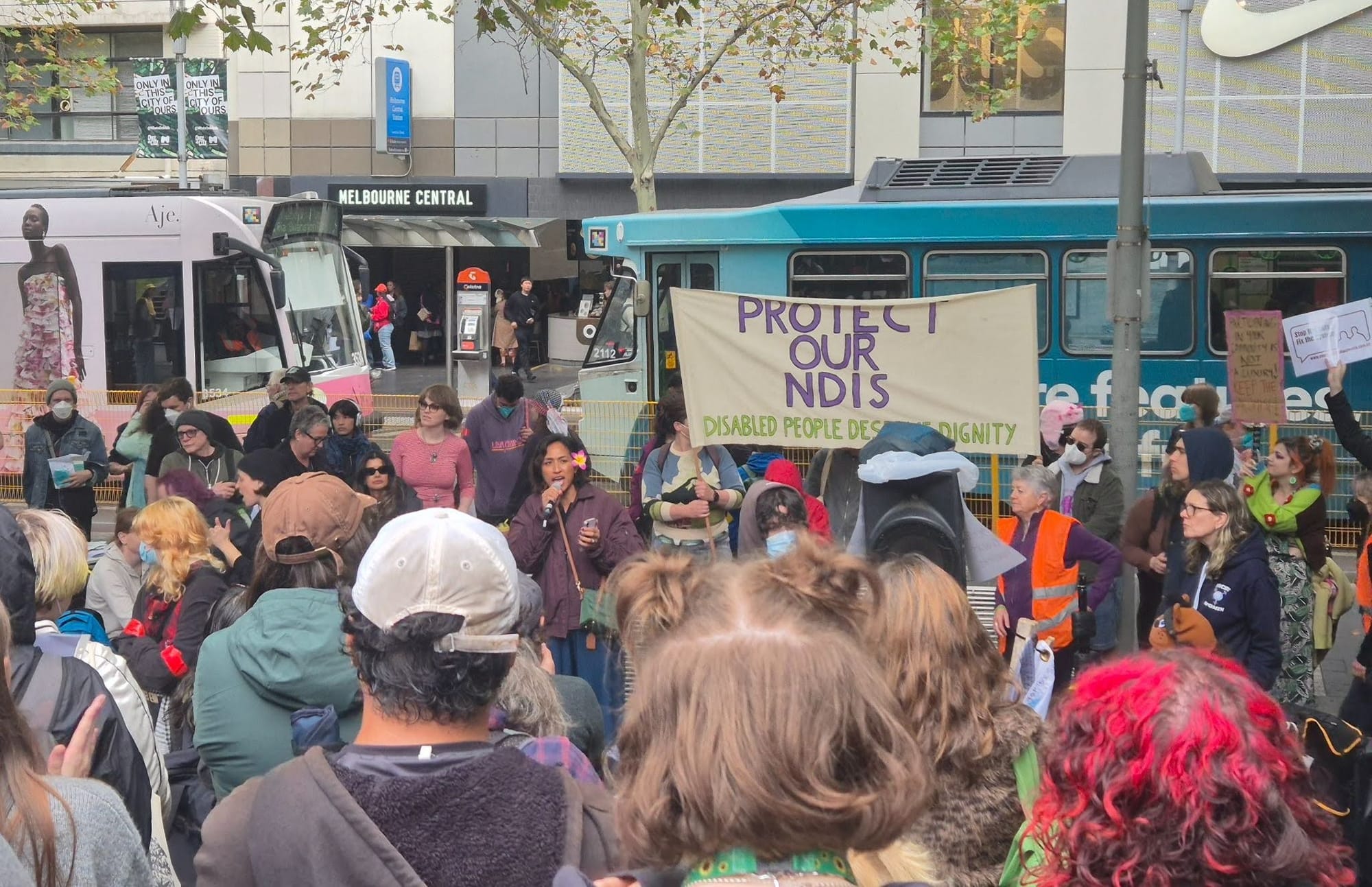
These cuts came with instant controversy. Despite protests breaking out across the country following the announcement, Parliament passed the NDIS reform bill on 19 August, with the changes due to come into effect on 1 January 2028.
History repeating itself
Paul Cormack, 54, is a legally blind NDIS participant who is also part of an advisory panel for disability advocacy in metropolitan Adelaide.
He said the NDIS helps him with basic needs such as help around the house and garden, transportation, and community support.
Cormack worries the new functionality tests will push those with more invisible disabilities out of the NDIS.
‘‘I see disabled people going back into the shadows, going back into places where they're not seen or heard,’’ Cormack said.
‘‘People won't ping me as a disabled person, so my fear is… they'll say, look how high-functioning this person is, he doesn't need to be on the NDIS Scheme.’’
Cormack grew up in the 1970s and 1980s during the era of deinstitutionalisation of the disability sector.
Dr Kate DeBruin, a Monash University education academic, considers that period to be a complex time of Australian history.
Specialised schools and institutions were systematically shut down in the name of integration in the 1970s and 1980s. This was spurred by the UN’s Declaration of the Rights of Disabled Persons in 1974 and genocidal experiments conducted on disabled people in World War II.
DeBruin says that while this reform was progressive for its time in trying to reverse the segregation of disabled people from society, a lack of preparation meant many students were pushed into worse educational situations.
‘‘That led to teachers saying, hey, look, we weren't prepared to do this, we didn't know, nobody had trained us for this, we're not resourced for this,’’ she said.
She also said much of the policy was built with a lack of consultation from disabled students.
‘‘It was the case during deinstitutionalisation and it's been the case since,’’ she said.
When Cormack graduated from his primary education at a school for the deaf and blind, the only option was for him to enter the public schooling system for high school.
Cormack recalled the effect this had on his childhood, coming from a school where most of his peers faced similar challenges into underprepared mainstream education.
‘‘All of a sudden I was back to being the one visually impaired kid,’’ he said.
‘‘I struggled in high school and that was I think that was one of the root causes of it.’’
DeBruin worries the NDIS might have a similar effect on disabled students’ education by limiting the funding that helps them get to the school gates.
‘‘NDIS cuts affect the kinds of supports people can access [and] may impact people's ability to get to school,’’ she said.
Dr Robert Jackson, an adjunct associate professor at Curtin University's School of Occupational Therapy, Social Work and Speech Pathology, and a board member of disability advocacy network All Means All, theorised what a lack of NDIS funding and support could look like for disabled students beyond just schooling.
‘‘Can someone… make sure that he gets off to the birthday parties? And primarily, if he’s at school, he’s supported in school, and there's an action to make sure he’s surrounded by the kids, not bullied and separated?’’ he said.
Reducing costs or unfair punishment?
Mark Butler argued in his announcement that the NDIS’s survival depended on reducing costs.
‘‘We have to make sure it is sustainable now, and for future generations,’’ he said.
The NDIS database shows an average of $84,000 is committed to each participant annually.
In 2021, think tank Per Capita found the current scheme to be economically beneficial, with every $1 spent typically generating $2.25 back for the Australian economy.
Cormack feels cuts could be made across other sectors.
‘‘Tax rich companies and individuals… rather than doing off the backs of disabled people,’’ he said.
Butler also blamed overspending on certain providers who were ‘‘shonks and rorters,’’ claiming that the Fraud Fusion Taskforce found the NDIS to be highly susceptible to fraud.
Independent researcher Talbot Mills found that seven out of 10 NDIS participants struggle with dodgy providers.
But Cormack still believes disabled people are being unfairly punished.
‘‘You're shunting the burden of compliance of shocking operators squarely back on disabled people.’’
Dr Jackson said the lesson from history needed to be learned about centring disabled people in the discussion of their own needs.
‘‘What do we need to change in this environment for the person to be able to thrive?’’ he said.
‘‘As soon as you're saying that person doesn't fit here because he doesn't fit our system, it's not going to work.’’
Sudhashree Somers feels the cuts meant a negative impact not just for disabled students, but for the whole community.
‘‘We're not going to give people with disabilities the chance to live an ordinary life and to have their human rights recognised,’’ she said.
‘‘We need to work together on this: people with disability, carers, the government, our whole community need to work to make an accessible safe, kind, caring Australia.’’


